Showing posts with label lamb. Show all posts

Tuesday, 12 April 2011

Lamb & apricots páté


I have just found out that today is… Chocolate Day. I haven’t got anything chocolate, but I have something that you may find handy for upcoming bank holidays. I will try to remember next year about the chocolate!

About year ago I made my first baked pate – chichen, orange and caramelised shallots páté. Now I know exactly how to make this kind of páté and I experiment with different types of meat and other ingredients. So far the best one I have made was lamb and apricot páté, made in very similar way as the previous one. It is not a rocket science and the taste is great. What probably more important I know exactly what is in it. Not like with those shop bought… (did you ever read the label?)

I encourage you to make your own, I know it can be time consuming, but the results are worth it. It goes really well with cranberry sauce (please, please, please - do not eat it only at the Christmas table, it so tasty it should be eaten more often), roasted beets & horseradish relish, or caramelised red onion. Next time I will try to make nice jelly topping.


1.8kg lamb shoulder (about 1.1kg when roast and boned)
2-3 tbsp olive oil
2 small carrots, cut into chunks
5-6 whole black peppercorns
1 bay leaf
2-3 allspice
2-3 garlic gloves, unpeeled
few springs of fresh thyme (I used lemon thyme)
few springs of fresh mint
big handful of dried apricots
about 175ml dry white wine
300g pork or chicken livers
about 30g butter
300g pancetta, diced (or smoked bacon lardons)
2 shallots, peeled and chopped
small stale bread roll
50ml brandy
salt
freshly ground black pepper
3 whole eggs
10-12 rashes of smoked streaky bacon or pancetta
cup of vegetable or chicken stock (optionally)

Heat the oven to 150 C.

Rub some salt, pepper into a lamb shoulder and fry on each side in olive oil until lightly browned. Place in an ovenproof casserole and add the oil remaining in the frying pan. Add carrots, garlic, mint, thyme, apricots, wine, whole peppercorns, allspice and bay leaf. Cover and roast for about 2.5 hours.

Fry the liver in the half of butter in the pan until browned, then remove from a pan and place in a bowl.

Using the same pan fry pancetta cubes without any extra fat until slightly browned. Remove from the pan and place in the bowl together with liver.

Still using the same pan fry the shallots in the remaining butter over very low heat, until golden, not browned. Add to the bowl with rest of ingredients.
Soak bread roll in some water, remove any excess of liquid and place in the bowl.

When lamb is cooked, remove from the oven, let it cool down, bone and add the meat to the bowl. Discard mint, garlic, allspice, bay leaf, but keep all the juices, thyme, apricots, carrots. Roughly pick some leaves from thyme and discard the tough bits.

Mince all the above ingredients three times using meat mincer, season with salt, pepper, add brandy, egg yolks and mix thoroughly with your hands. If the meat seems a bit dry add some liquid from roasting a lamb, alternatively you can add some extra stock. You should be able to mix this gently with stiff egg whites.

Whisk the egg whites with pinch of salt until they stiff and fold gently into the meat mixture.

Line big loaf tin (or use 3 small disposable tins) with bacon or pancetta slices, so they slightly overhanging the tin, fill it with a meat mixture, level with a spatula and cover with the overhanging bacon.

Cover the tin with a kitchen tin foil, place in bigger dish filled with hot water (about ¾ of the size of the loaf tin). This is called bain-marie, which is a type of preparation used for protecting dishes requiring gentle heat from the fierce heat of the oven.

Bake for 1 hour in preheated oven (180C), uncover and bake for further 10 minutes until the top is golden. Remove from the oven, let it cool down and leave in the fridge overnight before serving.

Saturday, 15 January 2011

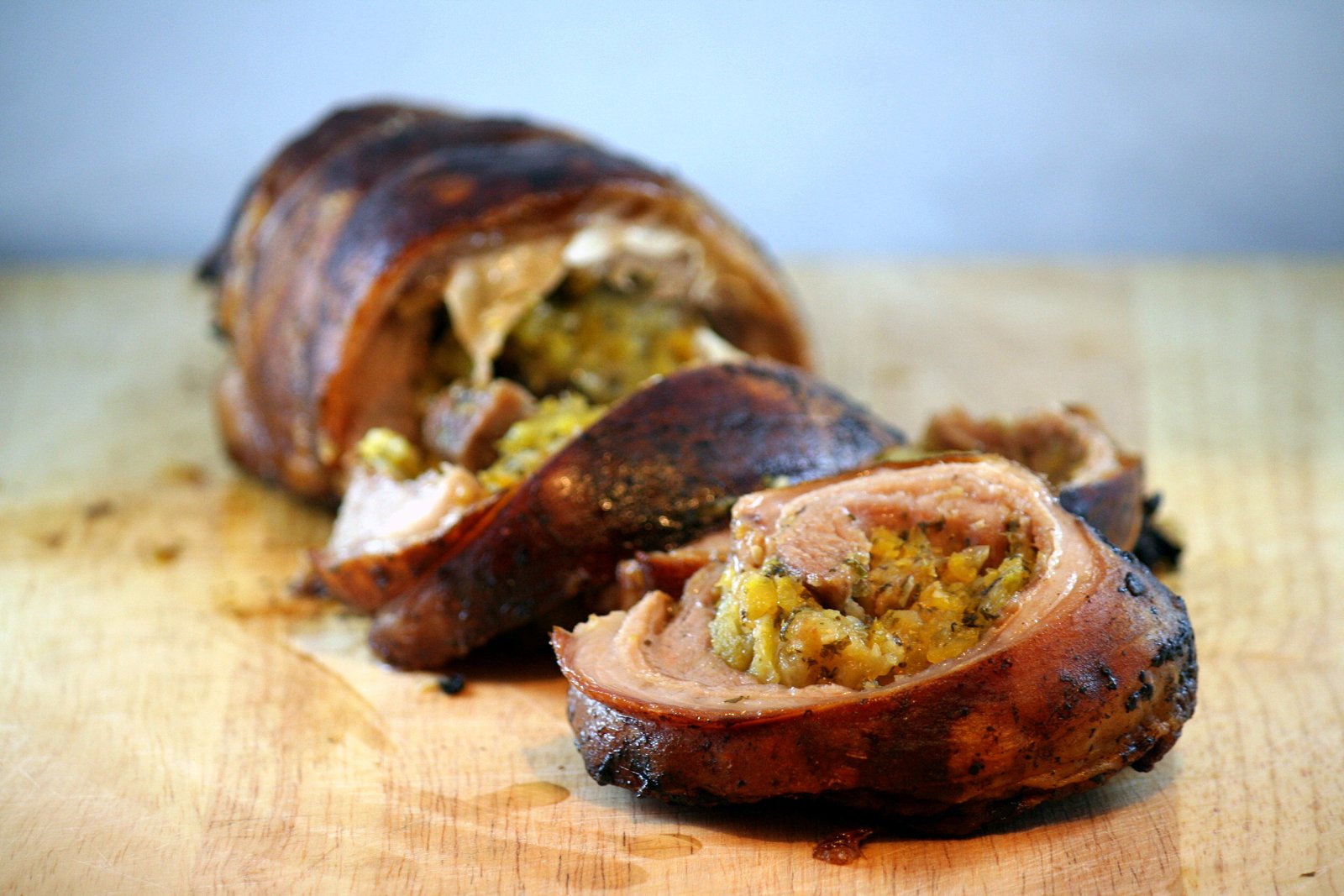
Lamb breast with apricot stuffing


Sometime ago food was not widely available and was not relatively cheap people were not wasting any bits i.e. after slaughtering a cow, only because some bits were less tasty than others or needed more effort to cook. It is not only the industrial revolution age that I am writing about when some people's only dinner were cheap eat cuts or offal; the food was rationed in Britain until mid fifties. People in age of fifty or so do not remember those days but older generation still remember times when some product were difficult to get hold of.

The food market has changed and in general the food is widely available and relatively cheep nowadays for most western societies. Some of the old times dishes are nearly forgotten now. You still can see some offal on the menu in traditional pubs or some good restaurants, but these are not very popular in many homes. It is similar with some cheap cuts such as belly pork that I showed you on this blog and lamb breast that I am showing today.

Both cuts are very cheap and I have to admit that they are not extremely meaty but fatty. However fat makes them really tasty, aromatic and meet underneath is very tender. Coked in low temperature for long time will provide lovely crispy skin and the centre that melts in your mouth. All they need is bit more time to cook and few culinary tricks.

Today the recipe for lamb breast stuffed with apricots. There are not many recipes on-line so I have asked my butcher how to cook it and I have improvised with the stuffing. The result was amazing and I going to cook this cheap, tasty, forgotten cut more often.


Serves 2


ok. 700g lamb breast
1 onion, peeled and chopped
2 garlic cloves, peeled and roughly chopped
handful of dried apricots
2 slices of stale baguette, diced
4 tbsp olive oil
small handful fresh mint
freshly ground black pepper
lemon & thyme salt (or sea salt)
cup of vegetable stock
3/4 cup of dry rd wine

Fry the onion in the 3 tbsp olive oil until soft but not browned. Add the garlic and fry for another minute or so. Remove from the heat and set aside to cool down slightly.

Place diced baguette, apricots, mint, some salt and pepper in the food processor. Add fried onions with garlic making sure you scrap as much olive oil as possible - it will help the stuffing come together. Process, but not until very smooth, but some little pieces of fruit are left.

Smear the stuffing over lamb breast, roll it and secure with a string. Heat the remaining olive oil in the pan that you have used for frying the onion and brown the meat on each side over a high heat.

Place the meat in an ovenproof dish, add wine and half of the stock, cover with piece of tin foil and place in the oven preheated to 140 C. Roast for about 3 hours, then uncover, add the remaining stock, turn the heat up to 180 C and roast for another 40 minutes (uncovered).

Remove from the oven, place on a chopping board, cover with piece of foil and leave it to rest for about 10 minutes.

Cut into slices and serve. We had it with potatoes, carrots, parsnips roasted in goose fat with garlic.

Saturday, 2 October 2010

Polish dumplings (pierogi) with lamb


I hate to waste any food, especially meat. I have written about it few months ago. It is no good for the environment but also from an economical point of view it is something unforgivable. It is like taking a note out of my wallet and putting into a shredder.

Therefore I try to cook some of our meals using products that are not at their best, but can be used in soup or stews – like wrinkly vegetables, or cheese that seems to be bit dry on the edges. Also I am not panicking about products that have passed the best before date – they are still OK to eat!

When we have a roast lamb, shoulder or leg that weights about 2 kg it is always too much for two of us, and after two days of eating the roast, we always have some leftovers. So I put them in a plastic bags and place in the freezer. This is how I ended up with 500g of meat that I used to make a filling for Polish speciality – pierogi.

It is quite common to stuff them with meat, seasonal fruit or mix of mashed potatoes and curd cheese. This is my recipe and I would not call this filling a traditional Polish stuff, as lamb is not the most popular meat in Poland, although pierogi are typically Polish and were incorporated to Polish cuisine from the Far East through the Kievian Rus. This is something that is very popular in most of the Polish homes and places serving food and there are numbers of different fillings used. In Poland you can get them in most shops, usually frozen.

There are different ways to make the dough. One, very traditional mix flour with egg and some water and the other which I prefer to use mix flour with buttermilk. The dough made from buttermilk is easy to roll, very flexible and pleasant to work with. However I will post both recipes, so you can use whichever you prefer.


Makes about 40 dumplings


For the dough:


300g plain flour (you have to have some more flour handy to work the dough and roll it out as it can be quite sticky)
half tsp salt
1 egg
about 100ml warm water
1 tbsp oil (optional)

Like making pasta dough sieve the flour onto a worktop and make well in the centre. Place the egg, salt and oil in the well and mix all the ingredients. Next add little bit water at a time and mix the dough with your hands until you have got a ball. You can use a planetary mixer instead. The dough should not be too sticky, so when making it you may have to add some extra flour.

Alternatively mix the following:

500g plain flour
about 300ml buttermilk

Again, you have to have some more flour and buttermilk handy, so you can adjust the recipe if needed. Again, the dough should be flexible and not too sticky. I prefer this one, as it is easier to assemble and the dough is very good to work with.

Either way you prepare the dough, divide it into 2-3 pieces and cover with cloth before rolling out.


For the filling:


about 500g roast or boiled meat leftovers (I used parts of lamb leg and shoulder and also small piece of beef boiled to make a broth on previous day)
140g cubed pancetta
large white onion, peeled and diced
3-4 tbsp butter
handful dried porcini mushrooms
2 springs of rosemary
cup of vegetarian or beef stock (optional)
salt
freshly ground black pepper


Soak the mushrooms in a cup of water for 10 minutes, drain and squeeze the excess of water, save the water for later.

In a dry pan fry the pancetta until brown, place in the bowl and set aside.

In the same pan melt the butter and fry the onions and rosemary springs. Remove the rosemary and discard when the onions are soft.

Mince the meat, pancetta, mushrooms and onions using a meat mincer. Add the water from soaking the mushrooms and mix well. The filling should be firm and quite sticky, so add more stock if needed. You should be able to form a firm ball without any problems. Season with salt and pepper.

Start to roll out the dough on a lightly floured surface. If you use first type of dough you can use a pasta maker to roll it out, unfortunately the buttermilk dough is not suitable for rolling out in the machine. Although it is really easy and pleasant to roll out with ordinary rolling pin.

When dough is rolled out, cut disks using a pastry cutter or glass or tea cup. Any scraps of leftover dough put together and knead to form a ball that you will roll out later. If you use the first type of dough it could become too dry to seal the edges, so you will have to brush them lightly with little water.

Place a generous spoon of the filling into a middle of each disk. The edges must stay clean as it will not seal properly with any filling between edges. Fold disk in half and pinch the edges together with you fingers, pressing lightly. Place it on floured surface and repeat with other disks.

At this stage you can freeze uncooked dumplings and boil them from the frozen next time. I prefer to cook them all and reheat next day – either fry in butter or steam them.

In the large pan (I use 5l) boil the water with some salt. Add few dumplings at a time, about 6-8 and bring them to the boil. They should rise to the surface and boil for about 3-4 minutes. Drain one with slotted spoon and check if the dough is cooked. If so, drain all of the dumplings with slotted spoon and serve.

We had it with some onions, which I have fried in butter and then cooked in some homemade beef stock and then sprinkled with fresh chopped parsley. You can also serve it with melted butter only, or fried pancetta cubes, or fried onions.


(source lovefoodhatewaste.com)

Tuesday, 7 September 2010

Spicy roast leg of lamb


I like living in the countryside. Sometimes I complaint about cinema or shopping centre being so far away, but I rather go shopping few times a year (it is whole day challenge) or travel to nearest fitness centre twice a week but come back from work to quiet and peaceful environment. Here a walk to the river or Pennines hills is a matter of minutes. Also I have an opportunity to buy some products from local producers such as free range eggs or meat. I pay a good price and I know exactly where the meat comes from and this is extremely important for me.

Few weeks ago my partner ordered a half lamb from a local farmer I mentioned some time ago. Surprisingly the meat was ready to collect few days earlier than we have expected so my partner went to get it and I was trying to empty our small freezer. I have managed to place everything in there and now we are stocked for good few moths.

Today I am going to show a recipe from “Indian food made easy” by Anjum Anand that I love and it would be perfect for those who do not love the smell of lamb. It is marinated for long time and spices make this meat very aromatic without a typical lamb smell. Although the smell is not totally gone. I have changed the quantities and method slightly.


approx. 2 kg leg of lamb


For the marinade

2 tbsp vegetable oil
5 tbsp lemon juice
approx. 5cm fresh ginger, peeled and roughly chopped
6 large cloves garlic, peeled
1 tbsp ground cumin
1 tbsp ground coriander
¼ tsp red chilli powder
1 tbsp garam masala
salt
freshly ground black pepper
2 tbsp water


For the honey rub

100g almonds, blanched
150ml Greek yoghurt
2 tbsp honey

Blend together all the ingredients for the marinade in a blender or food processor.

Trim the excess fat and membranes from the leg of lamb. Make deep regular cuts all over the flesh with a short, sharp knife. Rub in the marinade, making sure you get it into the deep cuts. Place the lamb in a plastic food bag with the marinade and leave in the fridge, ideally for 24 hours.

Next day for the honey rub place all the ingredients in a food processor and blend. Take the lamb out of the fridge and remove the plastic bag. Rub the honey blend into the lamb and ideally leave the lamb for another two hours, covered, in the fridge.

Remove the lamb from the fridge and bring to room temperature before cooking and preheat the oven to 225C. Place the lamb in a ovenproof dish with cover and roast for 15 minutes then lower the temperature to 180C, add half glass of water and cover. Roast for another 1 hour 40 minutes. Uncover for last 10 minutes.

Remove from the oven, cover with kitchen foil and leave to rest for about 10 minutes.

Carve and serve with potatoes and vegetables.

First day we had it with roast potatoes and Vichy carrots. Next I have carved all the meat off the bone, placed the bone in a pan added some water and boiled for about 1 hour over a low heat. I used the stock to cover meat leftovers and made sure all the almonds from roasting are added to the gravy as well. Next day I served lamb with this gravy and creamed potatoes and green beans. Any meat leftovers I freeze and going to use it when making pate or for Polish dumplings (pierogi) filling.

Thursday, 12 August 2010

Moroccan style lamb chops


Few days ago we had a sentimental journey back to Morocco, where we spent some time last September and we certainly will not forget this paradise of aromas and various flavours. I wanted to introduce lamb to my Mum, because she has never tried it - it is not popular in Poland and difficult to get hold of. Also, I needed this journey back to Moroccan vibe because the last few weeks in Yorkshire were quite cold and wet (we even had hailstorm yesterday!). So I grabbed a cup of spicy tea and flicked through our last holidays photographs, while this spicy lamb was in the oven.

You can use any cut of lamb, but preferably with some fat - it will keep the meat moist and tasty.


Serves 3


6 lamb chops
2-3 tbsp ras-el-hanout - Moroccan spice mix
2 tbsp sunflower oil (or other neutral)
2 onions, peeled and roughly diced
3 galic cloves, peeled and finely chopped
400g tin of chopped tomatoes
2 handfuls of dried apricots
handful of raisins or sultanas
handful of flaked almonds
few saffron strands, soaked in tsp of cold water
1/4 tsp turmeric
1/4 tsp cayenne pepper
1/2 tsp ground cinnamon
1/2 tsp ground ginger
1 tsp sweet paprika
approx 200ml vegetable stock
tbsp honey
salt
handful of fresh mint
juice of half lemon
couscous


Sprinkle the meat with ras-el-hanout, cover with kitchen foil and leave in a fridge overnight.

Next day fry the lamb chops on the high heat in a pan with oil until browned and place in casserole dish. In the same pan fry the onions and garlic, do not brown. Add to the meat.

Add the tomatoes to the pan and keep over a heat for minute or two, then add to the meat.

Next add the stock and de glaze for a minute, scrapping anything that was left in the pan. Next add to the casserole dish.

Add apricots, sultanas, almonds, cinnamon, ginger, paprika, cayenne, saffron, turmeric and honey. Cover and bake in the oven preheated to 150 C for two hours.

I served it with couscous mixed with lemon juice and chopped mint.


Sunday, 25 April 2010

Lamb shanks & butter bean mash


For lamb shanks

Serves 4

4 lamb shanks
2 garlic bulbs, unpeeled, cloves separated
4 celery sticks, roughly chopped
2 onions, peeled and quartered
few springs of rosemary, leaves picked
few springs of thyme (optional)
2 large glasses dry red wine (I used shiraz, I like its spicy flavours in meat marinade, cabernet sauvignon will be fine)
salt
freshly ground black pepper

Tear off four pieces of tinfoil large enough to make parcels for lamb shanks.

Divide the garlic, onions and chopped celery between them, making a pile in the middle of each square. Place the lamb shanks on the top of each pile and season with salt and pepper, sprinkle with rosemary and thyme. Carefully pull up the sides of the foil around the shank and pour a half of glass of wine into each. Gather the foil around the bone, pinching it together tightly.

You can leave it to marinate for few hours, but it is not necessary. If marinating remove them from a frige at least 30 minutes before roasting.

Place them in an ovenproof dish. Preheat the oven to 150 C and roast lamb shanks for about 3 hours. Meat will be very tender.

Before serving remove meat from the parcels and using a sieve save juices and remove all the veg and herbs. You can place it in a saucepan, add some cream and flour and boil for 2-3 minutes until thicken. I leave it as it is and serve on the side in a gravy boat.

I served lamb shanks with boiled green beans with some melted butter and glazed baby carrots (boil them al dente, drain and place in the pan with some butter and 2-3 sprinkles of muscovado sugar, fry for 5 minutes). Also I have made a bean mash (as seen in one of Nigella Lawson's books), because I think beans go very well with the lamb.

Butter bean mash

Serves 4

3x400g tinned butter beans
spring of rosemary
garlic clove, unpeeled and lightly crushed
6 tbsp olive oil (sometimes beans "take" more)
salt

Place olive oil, garlic glove and rosemary spring on a pan and fry for 3-5 minutes until olive oil is infused. Remove rosemary and garlic and discard.

Drain the beans and add to the pan, cover and after 5 minutes season with salt and mash them using potato masher until smooth. If is too dry add some extra olive oil or butter.

Monday, 5 April 2010

Meat comes from Tesco...


I do not wish to write a pro or anti vegetarianism post. As a teenager I was a vegetarian for two years because as a child I did not like meat at all. It was very difficult for my Mummy, because early years of my childhood had fallen into a time of communism in Poland, when lack of everything in the shops was very common. People were queuing for hours outside the shops from very early morning hours and they were lucky if they managed to buy some pork meat. I was quite fussy child when it came to eating a meat, even it took a hell lot of effort to get it.

Therefore it was very easy to make a decision about becoming a vegetarian. Although I have come back to eating meat and for the last ten years I have been a meat eater, I have to admit that my three favourite dishes are certainly vegetarian. I am very glad that I was a vegetarian because it helped me to learn some new kitchen skills, I was introduced to a lot food products that I never thought about when eating a meat.


On the other hand when I moved to Yorkshire I found local beef and lamb extremely tasty and I really enjoy eating them. Although I eat meat rarely, I could not even think about coming back to the vegetarianism. Even after last weekend when local farmer Tom Fall of Danby Grange kindly allowed me to spend some time with new born lambs.


When I think about my childhood I clearly remember that my parents did not allow me to waste any food. Perhaps due to the lack of many food products in the shops during the communism, and the way they nearly had to “hunt” for food, maybe because this was the way they were brought up by their parents. They always taught me to respect food.

It is very sad that Brits waste 60% of edible products (excluding peels, teabags and bones), therefore in average wasting 15 pence of every pound spent on food shopping. Some of these products that ended up in British bins not exceeded use by, or best before date. This could be an effect of the food being widely available in the shops and therefore the attitudes had changed since the war years when it was a crime to waste food.

Also British children are unaware of where the meat comes from. A recent study in the UK shows that 11% of children age 8-15 do not know where the pork chops come from. The study also showed that children that were brought up in cities are twice as likely as countryside children to be not able to identify that beef burgers come from cow. In my opinion children should get to know where the food on their plates come from, as this could teach them respect to food, and to meat especially. It is so worrying that if kids are asked where meat comes from, they say Tesco...


Some time ago Gordon Ramsay showed scenes of lambs being slaughtered to millions of viewers on his TV show. He also involved his children in helping him to look after lambs and had been throughout the whole time they were at their home. PETA said that a number of people, put off by the slaughter had called the charity since TV broadcast to request vegetarian starter packs. Vegetarians should certainly be grateful to Ramsay.

It is not my aim to judge whether he did it to increase the number of his show viewers, for publicity and to get a bit of controversy, but in my opinion he did a good thing - he showed where meat comes from. If you are not comfortable about what happens before meat ends up on your plate become vegetarian. It is entirely your choice as long as you are informed. If it does not worry you then carry on eating meat.

Perhaps the knowledge about where the meat comes from, will make some people more respectful to it. I do not wish to discuss if eating the meat is or is not moral, but in my opinion having this kind of knowledge and at the same time wasting meat is certainly unethical.

Saturday, 6 March 2010

Slow roasted shoulder of lamb


Makes 4-6

Approx. 2kg lamb shoulder, excess of fat trimmed
whole bulb of garlic, divided into cloves, unpeeled
few springs of fresh rosemary
few springs of fresh thyme
3 tbsp olive oil
large glass of dry red wine
salt
freshly ground black pepper


Rub olive oil over the lamb shoulder, season with salt and pepper and fry in the pan for few minutes over a high heat until browned.

Place lamb shoulder in ovenproof dish, with end of the knife make few holes in the meat and put some fresh rosemary inside them. Arrange remaining rosemary and thyme over the shoulder, put garlic cloves in the dish, add wine, cover and roast for about 3 hours in 150 C.

I served it with some roast cherry tomatoes, boiled brussels sprouts sprinkled with roasted almond flakes and potatoes wages roasted with rosemary, olive oil and sea salt. Lamb goes very well with creamy mashed potatoes, mashed butter beans and boiled or roasted vegetables like carrots, green beans, swede.