Showing posts with label meat. Show all posts

Tuesday, 30 October 2012

Red cabbage with black pudding, apples & hazelnuts

Recent recipe, so sorry I am late again with English version, two more to come that should have been done ages ago and every so often I wonder if I should stop writing this blog. :/

***

This is a recipe from some ancient "Good Food" magazine and today I am not even entirely sure if this is exactly how I should have made it. I also wasn't too sure if it looked good enough to photograph it. As much as I love the ingredients and these all seemed like a perfect harmony to me, when I plated this dish I thought to myself: what a mess. I took photographs, we sat and ate our dinner, really enjoyed it and after couple hours I went back to my computer to see the photographs and decided I was too harsh at first. Considering this is a cabbage dish and they never look in as fantastic as some Michelin starred and styled ones (well not in my kitchen anyway!) this is actually quite attractive looking one. It is surly great Autumnal dish whether you like the way it looks or not, you should try it.  


Serves 2-4

1 small red cabbage, core removed, cabbage shredded not too finely
2 small sharp apples, peeled, cored and cut into chunks
4 bacon rashers (I used smoked streaky)
4 slices of black pudding
handful of hazelnuts
pinch of brown sugar
1 tbsp of sunflower oil
1 tbsp of butter 
1 tbsp cider vinegar
2tbsp olive oil
1 level tbsp wholegrain mustard
1 tsp of honey
salt
freshly ground pepper

In a large pan heat the oil and add shredded cabbage with little salt, stir fry for about 5 minutes and then add 3-5 tbsp of water, stir, cover and simmer for about 3 minutes. Remove from the heat and leave covered so I doesn't cool down too much.

Prepare the dressing. Whisk olive oil, cider vinegar, mustard, some salt and pepper in a bowl, then set aside.

Dry roast the hazelnuts in a frying pan until slightly browned and then set aside on a chopping board. Chop roughly and leave them to use later.

In the same pan fry bacon witout adding any extra fat until browned and crispy. Move the bacon on the side of the pan (or just spoon it out, I didn't want to use another dish), and in the bacon fat fry black pudding slices - British black pudding needs about 2-3 minutes each side.

Meanwhile in another pan melt the butter, add apples and sprinkle with sugar. Fry until slightly browned, caramelised on the edges (about 5 minutes).

Place warm cabbage into the bowl with the dressing and mix. Adjust the seasoning - add some salt and pepper if required. Divide between warm plates, sprinkle with bacon, add caramelised apples and top with slices of black pudding. Sprinkle with chopped hazelnuts. 
You can serve it as a starter or like us add some potatoes roasted in duck fat and eat it as a main course. 

Tuesday, 23 October 2012

Steak tartare


This is something that I remember from my childhood, very popular party dish when I was a kid, for adults quite often served with a shot of very cold vodka. Couldn't quite grasp why people would eat raw meat, but once I got older I actually started to enjoy it. I think it was at least eight years since last time I ate it and then suddenly I had cravings for this dish last week.

Many Polish cooks would just mince fillet of beef. For me this is a crime. It is quite pricey, and by mincing it you destroy it's delicate texture. You may as well get cheap cut of lean beef and mince it, why do it to expensive fillet? Honestly I don't get it. So chop it finely, yet to the stage when you can still feel some texture under your teeth. Secondly, traditionally in Poland people would use onion, for me onion has too strong flavour and can overpower the flavour of beef. I use more subtle shallots. I would normally use diced pickled mushrooms but these are difficult to get hold of where I live, so I skipped them. I added cornichons and capers. I would advise to not to use strong flavoured oil, but something with a delicate flavour, mild olive oil or rapeseed oil. To enhance the beef flavour it is good to add some anchovies, and my last word: I never use mustard - I think it kills the meat flavour.  


So this is my take on this traditional dish.


Serves 2 

about 300g fillet of beef
1 small shallot (I used French variety, if British you need two)
2 medium cornichons (gherkins)
2 tbsp of salted capers
1 tbsp olive oil
2 small egg yolks (you can use quail eggs) 
4 anchovies (tinned or from a jar)
freshly ground black pepper
salt

Slice beef fillet into about 3mm slices and then chop into small dice. You can go again with a knife over the chopped meat, but do it roughly. Add minced anchovies (mince it with a side of a knife or a fork), some pepper and mix, adjust the saltiness by adding some salt according to your taste, but remember this dish will get more salty when you mix it with capers.

Peel the shallot and dice finely. Dice the gherkins and rinse the capers thoroughly under a running water then drain and chop roughly.

Place cooking ring on a plate and place one layer of meat then one layer of gherkins or caper or shallots, then again layer of meat and layer of next ingredient. Finish off with a layer of meat and make a little well in the centre. Gently place egg yolk in the well and sprinkle with some pepper and salt (optionally). Make sure you save some gherkins, shallots and caper for the finishing touch.

Using oil make three lines across the plate and place some gherkins, shallots and capers in each line. Remove the ring and serve immediately with good bread and optionally with a shot of good quality very cold vodka.

Sunday, 21 October 2012

My favourite sandwiches

This is one of them and there will be some more coming up some time in the future.

I like bacon & avocado sandwich, but Hugh came up with an idea of putting cheddar and mayo into this duo. I skipped mayo and added vintage cheddar to bacon and avocado and guess what? This is my new favourite sandwich. I used my everyday bread that I shared my recipe for some time ago, but this time made with white and wholewheat flour (and as usual rye starter).


2 slices of bread, slightly toasted
½ avocado, flesh scooped out and sliced or mashed
2 bacon rashers (I used back and unsmoked bacon), grilled in the oven or fried
2 slices of mature (or vintage) cheddar

I don't have to give you a method, do I? ;)

Have a lovely Sunday!

Thursday, 2 August 2012

I fight my demons, vol. 4

Knödel or semmel knödel (Germany and Austria), knedlík (Czech Republic) or knedel (Poland). This round, poached potato or bread dumpling (made without yeast) was giving me a right headache for a long time. I love this kind of food, not so keen on making it though. I was afraid something will go wrong, as I only had a general directions from one of my knedel guru I met on internet culinary forum. It probably took me more than two years to prepare mentally before I got round to make my own. Silly me. This wasn't difficult at all. The main thing is not to make the dough too wet, because it will be difficult to form the dumplings and adding more flour will make them too dense and unpleasant. These are even more delicious when reheated next day.

So my next culinary demon is officially defeated now and bread dumplings are going to be on my menu more often.  I am sorry about not posting an exact recipe for the bread knödel, you have to work your own quantities, as they may vary - depending on what bread you use. I only give you general directions for the dumplings but exact recipes for my pork goulash and beets that work so well with knedel

So you definitely need some stale bread, preferably rustic baguette or some good quality crusty bread. No cotton wool like sliced supermarket bread - forget about it! I used three ciabatta rolls and one large white homemade bread rolls - all 2-3 days old. Dice the bread and place in a bowl. Fry one diced onion in a little butter until soft. Add to the bread together with approximately one cup of milk mixed with two eggs, add lots of chopped fresh parsley, season with salt and pepper, optionally add some dried marjoram. Mix it with your hands, leave it to soak for about 30 minutes. Next add 2-3 tbsp of all purpose flour and  mix again with your hands. If you found the mixture too loose and too wet to form the dumplings add some breadcrumbs or some more diced bread - never add more flour. I ended up with 16 dumplings of a size roughly about a tennis ball.

Bring a large pan of salted water to the boil and using wet hands form dumplings about size of a tennis ball and add to the boiling water. Don't shake the pan, leave it, until they start to flow on the surface. From this moment boil them for about 10-12 minutes, then remove with slotted spoon. The bigger dumplings are the longer you have to cook them.

We had them with simple pork goulash and some beets cooked with orange juice. If you are not afraid of gherkins in salty brine called ogórki kiszone (as some people are, as they think they too sour or even gone off), popular in Central and Eastern Europe give them a go with dumplings and meat - they work perfectly well together. 


Pork shoulder goulash 

Serves 4

3 tbsp sunflower oil
about 800g diced pork shoulder
few tbsp all purpose flour
some salt
some freshly ground black pepper
1 onion, peeled and diced
2 garlic cloves, peeled and finely chopped 
3 tbsp sweet paprika
pinch of chilli powder
about  800ml vegetable or chicken stock, or lager or water
2 anchovies (optionally, I used them, because I had some leftovers)
small handful of dried marjoram

Place flour with some salt and pepper in a bowl. Add the meat and shake so it is covered with flour. Shake the excess of the flour and fry the meat in batches in a pan with sunflower oil. Do not overcrowd the pan, do it in 3-4 batches. Remove the meat from a pan and set aside.

Heat the remaining sunflower oil in a pan and add the onion. Fry for about 5 minutes, then add the garlic and fry for minute or so. Next add the paprika and the chilli and fry for a minute or so before adding the meat and any juices released when it was resting. Stir, add anchovies if used, stock or lager, marjoram, bring to the boil, low the heat to simmer, cover and cook fro about 1 hour.


Beetroots (roasted and finished with orange juice)

Serves 2

4-5 medium beets, washed and unpeeled
1 tbsp sunflower oil
salt
freshly ground black pepper
juice of one fresh orange 
1 tbsp balsamic vinegar 
1 tbsp butter

Heat the oven to 180 C. Place beets onto a baking tray lined with some kitchen foil, drizzle with sunflower oil, sprinkle with salt and roast until soft. Remove from the oven, leave it to cool down slightly, then peel and grate on a coarse grater.

Heat the orange juice in a pan and boil until slightly reduced. Add the grated beets, butter, balsamic vinegar, salt, pepper and cook for about 3 minutes.

Serve dumplings with goulash and beets on the side sprinkled with some chopped fresh parsley. To reheat the dumplings next day simply add them to the gravy and simmer for 5 minutes, or slice and fry in a pan with some butter.

Wednesday, 16 May 2012

Thyme & lemon chicken supreme, rhubarb reduction and roasted asparagus

My partner mentioned recently that I did not have a plate full of this popular trio of meat/fish, potatoes/or other starch and veg for a long time on my blog. I have to say this is not something that we eat on everyday basis; however this seems to be very popular in many, many homes (both British and Polish!). 

Therefore when next opportunity came I took some photographs of our dinner of meat, potatoes and veg. It was very nice but I thing the pièce de résistance was the rhubarb reduction. 

I love this veg and I am very fortunate to live in Yorkshire known from its delicious rhubarb. There is even something called the Rhubarb Triangle is a 9-square-mile (23 km2) triangle in West Yorkshire, located between Wakefield, Morley and Rothwell famous for producing rhubarb. They use to produce 90% of the world's winter forced rhubarb! Isn’t this impressive? Wakefield is know for its Rhubarb Festival and this is something that I like Brits for – they know how to celebrate small things and don’t need a huge, important reason to party.

We also had Yorkshire asparagus and some British new potatoes. If only the weather was better, I would believe we have the spring in full bloom!


Rhubarb & balsamico reduction

about 150ml 

1 tsp sunflower oil
1 tsp butter
1 shallot, peeled and finely chopped  
walnut size piece of fresh ginger, peeled and grated
2 rhubarb stalks, chopped into 1cm pieces  
1 tbsp dark muscovado sugar  
2 tbsp balsamic vinegar (I used cheap supermarket vinegar)
salt
freshly ground black pepper

Place the oil and the butter in little pan and fry the shallot over a low heat until soft. Add ginger and fry for another minute. Next add the rhubarb, sugar, vinegar and bring it to boil. Stir until the sugar is dissolved and turn the heat down. Add some salt and pepper and simmer until it is reduced slightly, about 25 minutes. Be careful – it can catch at the bottom of the pan, so stir it regularly. It can also spit quite a lot. Next sieve it using very fine sieve and return to the pan. You can simmer this for little bit longer, so the flavour and colour will be more concentrated. Serve warm.

We had some leftover reduction with cheese (instead of chutney) next day and it went together really well.
  

Chicken supreme with lemon and thyme  

Serves 2 

2 chicken supreme breasts  
2 tbsp sunflower oil  
2 springs of fresh thyme, leaves picked
2 tsp lemon juice  
salt
freshly ground black pepper

Heat the oven to 180 C (fan) and line the baking tray with some kitchen foil. Gently lift the sin off the chicken flesh and rub some lemon juice in it followed by some salt and pepper and thyme leaves. Pres the skin back and season with some salt and pepper.

Place the oil into a frying pan and heat. When hot place the chicken breasts skin side down and fry for few minutes until crispy and browned and turn on the other side. Fry for further 3 minutes.

Place the pan fried chicken breasts onto baking tray and loosely cover with kitchen foil. Place in the oven and roast for about 20 minutes, uncover the foil to allow the skin to brown more. After removing from the oven leave the meat to rest for about 5-8 minutes. This is the moment when you should place your asparagus in the oven. 


Roast asparagus with olive and smoked salt 

Serves 2 

8-10 green asparagus spears, wooden parts removed
1 tbsp olive oil
smoked salt flakes

Line a baking tray with some kitchen foil. Place the asparagus onto the tray and cover the tips only with a piece of foil – they are too gentle for the fierce heat of oven. Drizzle with olive oil and wait until the chicken is ready to be taken out from the oven, or place the asparagus about 3-4 minutes before removing the chicken. It depends how long you want to leave the meat for resting. I think 5 minutes is fine, I cover it with piece of foil to prevent from getting cold and in my opinion asparagus doesn’t need more that 5-8 minutes in the oven.  

In the meantime boil the potatoes – however you like them. I boiled mine in skins and peeled just before the serving also I brushed them with some good quality EV olive oil.

Now! How to put everything together:

Slice the chicken into few slices and arrange on the plate. Add some rhubarb reduction (or smear it like some chefs do), potatoes and asparagus. Sprinkle with little smoked salt just to finish off. Serve immediately.

Tuesday, 13 March 2012

Fennel & corriander roast leg of pork and how to make gravy


I absolutely love Sunday roast. This was one of those things I fell in love with when I first came to UK. This dinner just seems perfect to me: selection of roast meat, roast potatoes (preferably in goose or duck fat), veg and gravy. Oh yes, and my favourite bit – Yorkshire pudding that I can use to wipe a plate clean.

Today I show you my favourite roast pork. I think those that I found in the pubs so far were slightly too plain, I like it with a hint of spices and herbs. Sometimes I let myself go on a wild side and have some pork crackling as well (wink, wink!). 100% cholesterol, but sooo tasty!

I have to say I am terrified by the amount of gravy granules or other instant gravy that people buy in supermarkets. There is nothing easier than to make tasty, homemade gravy in no time, while the meat is resting. Is this laziness? Is this lack of knowledge? I don’t know, but it made me prepare a photo tutorial, how to make gravy in few easy steps.

Talking about the lack of knowledge I remember once when we went to one of the local pubs and one of the members of the staff who happened to be Polish warned us that under no circumstances we should go for this dark sauce that it is served with the roast meat, because chef makes it using all burn bits of meat and veg leftovers from roasting. [sic!] Do you find this not funny at all? Then you should definitely read the recipe below and then read this paragraph again. 

I hope you will enjoy it, as much as I enjoyed homemade Sunday roast (I will show all the trimming another time…) 

Serves 6-8

about 1.8 leg of pork, boned and rolled
few tbsp olive oil
1 tsp of fennel seeds, lightly crushed in a mortar
1 tsp of coriander seeds, lightly crushed in a mortar
1 tsp of dried thyme
salt
freshly ground black pepper
2 carrots, cut into big chunks (no need to peel, just wash them thoroughly)
2 parsnips, as above
2 pieces of celery, cut into big chunks
4 garlic cloves, unpeeled
2 onions, unpeeled, quartered
bay leaf


Heat the oven to 230 C.

In an ovenproof dish arrange all the veg.

Score the pork skin in about 1cm intervals (unless your butcher did it for you already). Rub in the oil and then all the spices and herbs, as well as salt and pepper. Place the meat on the top pf the veg.

Place in the oven and leave it for about 20-30 minutes until the skin starts to crack. Then turn the heat down to 180 C. If I roast pork with the fat and skin on I roast it for about 20 minutes in hot oven and then turn the heat down and roast it 20 minutes for every 400g of meat. If it has a bone I add extra 20 minutes. Therefore this piece of meat spent 1h 40 minutes in the oven.

Take a look few time and when the veg seem a bit dry or start to burn add little splash of water. (not on the meat)

When ready remove from the oven and set on a chopping board. Remove the string and carefully lift the fat and the skin. Remove the fat and discard, and set the skin on a baking tray. Turn the heat back to 220 C and place it in the oven.

Cover the meat loosely with some tin foil and leave it to rest. Prepare the gravy.

Extras for gravy

2 tbsp plain flour
a good splash of dry sherry, dry white or red wine
about 1l vegetable or chicken stock
salt
freshly ground black pepper

To prepare the gravy first get rid of any excess of fat from a roasting tin. Place it on a hob over a medium heat. Add the four and stir – do not worry if it goes bit clumpy, you will sieve it later. Keep it on the heat and stir for about 1 minute, then add the splash of alcohol (it will evaporate, but you can skip it if you wish to do so, however it gives the gravy an extra flavour) and then warm stock. Stir and let it bubble.

Then using a potato masher press the veg firmly. Try to mash them to get as much flavour as possible out of them. Boil for about 5 minutes.

Next sieve it using a fine sieve or cheesecloth. Season with salt and pepper and let it boil until it thickens to your likeness.  I also add the juices released by the resting meat.

I often add my secret (not anymore, sic!) ingredient – redcurrant or mint jelly (about tsp of it). I did not have it this time, but a pinch of sugar does the trick as well.

In this time meat should be ready for carving and the pork cracking should be nice and crispy. I also prepare veg and potatoes while the meat is roasting. I will write about this another time.     

Friday, 10 February 2012

Pork ribs braised in mead & sauerkraut

I am one leg in our old house and one leg in the new one. We still have plenty of things to pack and move, some cleaning to do in both places before we definitely change the address. Not much time to cook anything decent, but we cannot survive all week on the bowl of pasta with pesto (well, I can… My well built man seems to struggle on this kind of diet), so I try to cook one pot dishes that are suitable for reheating and keep us going in this busy time.

This is one of the Polish dishes that join two very popular in Poland ingredients: cabbage (in this case sauerkraut) and pork. I am sure there is quite a lot of different ways to make this dish, but this is my own and favourite way to cook ribs in sauerkraut – with a hit of sweetness from mead (honey wine) and prunes.  Also the fennel loves pork as much as the cabbage. This time I did not use the caraway seeds, typical for Polish cuisine. Hope you will enjoy it.

I hope to be back on the track soon, when everything gets sorted with the new home (end of February hopefully!).   


Serves 4-6

1.5kg pork ribs
4 garlic cloves, peeled and finely chopped
3 tbsp dark soy sauce
2 tsp smoked paprika
freshly ground black pepper
2 tbsp goose or duck fat
1 large onion, peeled and diced
1 tsp fennel seeds, slightly crushed
¾ cup of mead (honey wine - I used Polish dwójniak variety)
6 prunes, sliced into thin strips
2 bay leaves
2 all spice  
few whole black peppercorns
1.2kg sauerkraut, drained, about cup of fluid reserved
salt


First marinate the ribs, preferably overnight, or at least for 2 hours. Mix the soy sauce with chopped garlic, smoked paprika and pepper and rub into the ribs, cover and leave in a fridge.

When ribs are marinated, season them with little salt, heat the duck or goose fat in large heave bottom pan and fry the ribs on both sides until browned. Do it in batches, do not overcrowd the pan, so they actually fry not cook. Remove from the pan and set aside. Add the onions to the pan and fry for few minutes until slightly softened, then add fennel seeds and fry for about a minute, stirring all the time. Next add the mead and leave it to reduce slightly, using a spatula or wooden spoon scrap all the bits from the bottom of the pan – they have lots of flavour.

Next add the drained sauerkraut to the pan, as well as the marinate used for rinbs (if any left) prunes, bay leaves, peppercorns, some salt and all spice. Mix well; add the ribs and any juices they released during the resting, cover and simmer for about 30 minutes, stirring occasionally. If it seems a bit dry and starts to catch at the bottom of the pan during the cooking, add some fluid reserved from the sauerkraut.

Serve with some mash potatoes or a generous slice of good bread. It definitely tastes better when reheated and cooled down several times.

Wednesday, 16 November 2011

Italian style tripe


Finally I got round to cooking a tripe. Not that I have a childhood trauma or something, because in my closest family nobody ate tripe as far as I remember, however this is not very popular ingredient nowadays, especially in the United Kingdom. During the Industrial Revolution, especially in northern part of England tripe was a very popular snack. Poorest part of the society when coming back from shift in factories use to grab piece of tripe drizzled with some vinegar – it was cheap and fast food. There were special places where the whole process of cleaning and cooking quite smelly tripe took place. This is very interesting period in history of British food. On one hand there were poor working class people eating cheap cuts but on the other the Industrial Revolution changed the availability, distribution and production of food like never before. This period also brought the first food adulteration due to a rapidly increasing population. The food industry had a difficult time dealing with shortages of materials and in an effort to keep costs down, bulked up food items with bad quality fillers. One of the products that suffered the most was tea. On the other hand due to the expansion of railway system food was transported to the many places that could not get before. Faster transport meant better quality food available to more people... What I was writing about? Oh yes, the tripe.

Nowadays it is ingredient quite difficult to find and the whole process of bleaching and blanching the tripe is quite long and it makes tripe nearly as expensive as stewing beef. This could be a reason that people don’t buy it anymore and even good butchers don’t have it in stock all the time. I have ordered some and after searching the internet I found few Italian recipes. I didn’t want to cook tripe in traditional Polish way – spicy in broth with lots of marjoram, because my partner can’t stand them this way – I think he was forced to eat them when he was a child. So we both ate Italian style tripe and it was tasty, however it isn’t something that I would cook on a regular basis. I believe I haven’t found my perfect tripe recipe yet.  

This recipe is a compilation of few that I came across and to be quite honest the photos revealed something more stew like – thick, with little sauce. Mine tripe was more like a soup, thick and filling though. Marjoram is my addition, because I think it goes very well with tripe. As far as I am concerned this recipe is quite close to the traditional Trippa alla Romana, because of the use of wine and pecorino cheese. 


Serves 4-6

750g tripe, bleached, pre cooked and cut into strips  
4 tbsp olive oil
1 large onion, peeled
2 carrots, peeled  
2 celery sticks  
3 garlic cloves, peeled  
150ml dry white wine  
200ml vegetable stock  
2 x 400ml tins of chopped tomatoes  
2 peperoncino peppers  
2 bay leaves  
few tsp dried marjoram
salt
freshly ground black pepper  
handful of fresh mint, roughly chopped if large leaves
handful of freshly grated pecorino cheese (parmesan will do if you don’t have pecorino)

Chop the celery, carrots and onions very finely. I used food processor.

Heat a large pan and add olive oil. Next add the chopped vegetables and fry for about 5 minutes. Stir occasionally. Next add the wine and cook until nearly all of it evaporates. Add the tripe, whole garlic cloves, bay leaves, whole peperoncino peppers, tomatoes with the whole juice, stock to the pan. Season with salt and pepper (lots of pepper!), add marjoram, stir, cover, turn the heat down and simmer for about 2 hours, stirring occasionally.

Serve with some grated pecorino and fresh mint on the top.


Sunday, 30 October 2011

Sticky Five Spice Beef with Fried Ginger


I love the Five Spice mix. It's taste and the whole idea of five different flavours being five different energy fields: wood (sour), fire (bitter), earth (sweet), metal (spicy), and water (salty). Like the concept of yin and yang, the Five Elements Theory is at the cornerstone of Chinese culture. I am not an expert so please find some books or other materials related to this subject. I simply love the taste of this spice mix, even I not entirely sure what is included. Some of them have cumin, some not, others will contain cardamom, and use of pepper is not sure to me: Sichuan or black peppercorns? Nevermind. I get it ready from a shop and do not worry too much about making my own. Not yet, anyway. 

I found this recipe in last "Good Food" magazine and I found it very interesting. Sticky, sweet and spicy, very tender meat is something that I fancy a lot, so I pressumed (and I was right) that this will be an ideal meal for me. I did not use exact quantities. I used brasing steak as they are quite cheap, there is no point of buying more expensive cuts as after two hours of brasing, the meat will be very tender anyway.


Serves 2 

2 braising beef steaks, each about 200g, cut into four pieces
2 tbsp sunflower oil
2 onions, peeled and quartered
1 piece of fresh ginger, about 3cm, peeled
3 garlic cloves, peeled
small handful of fresh coriander (leaves + stalks)
2 tsp Five Spice
1 whole anise star
1 tsp black peppercorns, smashed in the mortar
2 tbsp of soft, brown sugar
1 tbsp dark soy sauce
1 tbsp light soy sauce
1 tbsp tomato puree
about 250ml beef stock
salt

Heat the oven to 140 C (fan).

Place the onions, ginger, garlic, most of the coriander (save some leaves for garnishing) in the food processor and whizz until smooth paste.

Heat the oil in an ovenproof pan, season beef chunks with some salt and fry oon both side, over a high heat until browned. Then remove from the pan and set aside in a bowl.

Add the whole paste to the pan, and fry for about 2 minutes, rinse the food processor with some water and add the remaining pf the past with the water to the pan. Add star anise, Five Spice, pepper, both soy sauces, sugar, tomato puree and stir. boil for about one minute and next add the beef with it's juices and the stock. Turn the heat down, cover and bring it to boil, then place in the oven.

After 2 hours check if the sauce is not dangerously reduced and close to burn, if so add some more stock. I braised my beef for about 2.5 hrs in low temperature.

Serve it with some cooked basmati or jasmine rice, garnished with some coriander leaves and fried ginger. it is perfect to finish off some Asian dishes.

Fried Ginger 

Serves 2-3

1 piece of fresh ginger, peeled and cut into matchsticks
1 tbsp sunflower oil

Heat the oil in a pan, over a high heat. Add ginger and stir fry until crispy and golden. Remove with a slotted spoon and rain the excess of fat by putting the ginger onto a paper kitchen towel for a while. Serve immediately.

Tuesday, 25 October 2011

Chicken livers with sherry & mustard mash


I sat in Italian restaurant having a plate full of delicious coratella and I thought to myself – offal, so tasty and so underrated. I decided that when I come back from holiday I will start to cook more offal dishes, depends on what I will be able to get at the local butchers. As I said several times before I thing we should use as much as possible from the animal that was killed and not waste any single bit that is edible. I love British black pudding, it's Polish version – kaszanka or Spanish – morcilla. I make real beef stock using beef bones that I get from butchers for free, otherwise these would go to waste. In many top class restaurants you will find some dishes made from cheap cuts of meat such as pig’s head. 

When I came back from holiday I came across a offal cookbook "Offal: The Fifth Quarter" , but I still wait for the price drop or at least for some more enthusiastic reviews. What made me to decide to cook some more offal dishes? First of all at the moment I am little bit fed up with any meat I eat – I have tried so many recipes and yes, they are tasty, but not surprising and offal is like unexplored planet to me. Secondly it is my ambition to learn how to cook offal – I will not learn how to do it?! And lastly I think it is not a big deal to buy beef fillet for around £20 per kilogram and cook tasty meal. It is a big deal when you buy the chicken livers for £1.29 and cook such a tasty dinner that you will not even think about beef fillet at all. 

I found new issue of “Good Food” magazine very helpful as it has lovely chicken livers recipe using dry sherry – I never tried it before and have to say when I finished I was really pleased with the result – extremely tasty dinner for around a pound a head. 


Chicken livers with sherry

Serves 2

about 50g butter 
2 medium onions, peeled and sliced  
about 400g chicken livers
50ml dry sherry
100ml chicken stock  
salt
freshly ground black pepper

Melt half of the butter in a frying pan and add the onions. Fry over a low heat until soft, for about 15 minutes. Remove from a pan into a bowl and set aside. Add the remaining butter to the pan and turn the heat up.

Wash the chicken livers, dry with paper kitchen towel, season with salt and pepper and add to the pan. Fry on both sides for about 3 minutes. Next add sherry, bring to the boil and leave it to bubble for about 30 seconds. Add the fried onions, stock, mix and leave it to boil for about 2 minutes, let the sauce to reduce little bit.

This way the bigger livers will stay pink in the middle, the smaller ones will be cooked but still soft. I served them with wholegrain mustard mash and after I took picture I realised that I have some Polish sour gherkins in brine left –they went perfectly with sweetish livers.  


Wholegrain mustard mash

Serves 2

5 medium potatoes, peeled, boiled and drained
tbsp of butter
2 tbsp of wholegrain mustard
50ml milk

Mash all the above until smooth and serve immediately.

Thursday, 20 October 2011

Chicken, butternut squash & date tagine

I have to admit I was inspired by several Moroccan recipes when making this dish, however I still do not have a traditional tagine dish and often wonder if it would work in ordinary European kitchen. Do you, dear readers, have this dish and use it in the oven or on the hob?

This dish is very easy to make and you can relax in total laziness while waiting for the dinner and smoke a pipe with bored facial expression, making those rings with a smoke. If long you use chicken on the bone the flavour will be more intense but you will wait longer for a dinner. I do not smoke a pipe and wanted this dinner quickly so I used boned chicken thighs.


Serves 3-4

4 tbsp of neutral olive oil
6 chicken thighs fillets (skinless) 
2 onions, peeled and cut into wedges
2 garlic cloves, peeled 
2.5cm piece root ginger, peeled
2 tsp ground cumin
2 tsp paprika
1 tsp harissa paste
juice and zest of one lemon 
large handful of fresh coriander - leaves and stalks
1 cinnamon stick
400g tin cherry tomatoes (or chopped tomatoes)
about 12 dates, stoned
about 350g butternut squash, peeled, seeds removed and chopped into large chunks
salt
freshly ground black pepper

First prepare the spicy paste. In a food processor place: one onion, garlic, ginger, most of the coriander leaves and all coriander stalks, lemon zest and juice, 2 tbsp olive oil, harissa, cumin and paprika. Mix until smooth.

Heat the oven to 180 C (fan).

In large ovenproof dish with a lid heat the remaining olive oil, season the chicken thighs with some salt and pepper and fry on both sides until slightly browned.  Remove from the dish and set aside in a bowl.

Add the whole paste to the pan and fry for about minute or two, next add the onion, squash and tomatoes. Rinse the food processor with some water and add to the pan - you will get all that remains and flavour into the dish and make the sauce less thicker. Next add the chicken with all the juices from the bowl, put the dates on the top, add cinnamon stick and cover. Bring to the boil and place in the oven.  Keep in the oven for about 40 minutes. Chicken on the bone, needs about 60 minutes.

For a change I served it with a quinoa, not a couscous, sprinkled with the remaining coriander leaves.

To be quite honest - it was very tasty, however in this kind of dishes I prefer the prunes or dried apricots. Even some raisins. However tried it yourself with different dried fruits to decide which is your favourite one.


Sunday, 16 October 2011

World Bread Day - Onion, bacon & thyme fougasse

Bake Bread for World Bread Day 2011

This year, first time I decided to take part in "World Bread Day". For this special occasion I baked French bread that I have done some many times before however never tried the version with meat. I baked fougasse with different herbs and cheese but this time I decided to go for bacon version. I hope that the vegetarians will forgive me this time and bake it omitting the bacon - the onion version must be as delicious. This bacon, onion and thyme fougasse bread traditionally shaped as a leaf is a great treat during this Autumn weekend.


Makes 2 loaves


500g strong white flour
7g sachet fast-action yeast
300ml water
4 tbsp olive oil + 1 for frying + 2 for brushing
1 tsp salt
1 large onion , peeled and finely chopped
3 rashers back bacon, sliced into thin strips or cubed
1 tsp thyme leaves


Mix 250g of the flour with all the yeast and approx 150ml water in a bowl, and beat together into a thick batter for 3 minutes. Leave to rise for about 2 hours. It should fall slightly after this time. Then add the rest of the flour, salt, water and oil, and mix well. When using your hands turn the dough out onto a lightly floured work surface and knead to a smooth dough. Otherwise use stand mixer. Dough should be quite sticky. Leave it in the bowl to rise for a further 2-3 hours, or like me - overnight in a cool place, covered with cloth.

Next day I fired the onion in the tablespoon of olive oil until soft and slightly browned adding thyme half way trough and placed in a bowl. On the same frying pan fry the bacon until browned, I did not use any extra fat. Set aside to cool down.

Line 2 baking trays with baking parchment. Knock back the dough, then knead to incorporate the onion and bacon - this can be quite tricky as the onions and bacon are covered in fat, however after minute or so they should incorporate into the dough. Divide the dough into 2 pieces, place each onto a baking tray and use a rolling pin to flatten out each piece to about 2cm high, then using your hands shape roughly into a leaf shape. Using a sharp knife cut three diagonal slashes right through the dough down each side and two down the middle to form the shape of a leaf. Brush with olive oil, cover with a piece of cling film, and leave for a further hour to prove.

Heat oven to 210C (fan) and bake the loaves for 15-17 minutes until golden brown. Cool on a wire rack.


Wednesday, 8 June 2011

Chicken, avocado & tomato salad


This salad is perfect when the weather is good, it is quite warm outside and you don’t feel like cooking or eating. Perhaps when you go for a picnic or a bike ride and do not know what to prepare for your re-fuelling snack. It is great to take with you to work, and have on your lunch break. It tastes as good with cold or hot meat, therefore very practical, also for those watching their figure, but do not want to fade away from hunger. This salad has good carbohydrates, healthy fat and some protein. More importantly it tastes great.


Serves 2


For the  salad:

2 avocados
juice of half lemon or lime
10-15 cherry tomatoes, halved  
handful basil leaves, torn if big
2 spring onions, chopped
few green asparagus, wooden bottoms removed, rest halved  
2 skinless boneless chicken breasts, slightly bashed on the thicker end  
2 tbsp sweet paprika
1 tbsp smoked paprika  
1/4 tsp chilli powder
salt
freshly ground black pepper
2 tbsp olive oil  


For the  dressing:

4 tbsp olive oil
2 tbsp cider or white wine vinegar  
freshly ground black pepper
salt


Mix all the dressing ingredients together and set aside.

Boil the asparagus in salted water for about 3 minutes, drain and leave to cool down in cold water, then dry and set aside.

Cut avocado in half, remove the stone and take the flesh out of the skin. Drizzle with lemon juice so it doesn’t become dark and dice. Mix with tomatoes, spring onions, basil, asparagus and dressing. 

On a plate mix sweet and smoked paprika, chilli, salt and pepper and toss chicken breast in the spices until covered all over. Heat a frying pan, add the olive and fry chicken on both sides. Timing depends on chicken breast size. Medium doesn’t need more than 4-5 minutes one side and then 3-4 minutes on other side, so it doesn’t become dry. Remove from the pan, set on a chopping board and leave it to rest for about 5 minutes. 

Arrange the vegetables on a plate, top with sliced chicken breast, sprinkle with some more pepper and some basil leaves.


Saturday, 16 April 2011

Blackcurrant glazed ham


In Poland we eat quite a lot of ham on Easter I know this recipe sound more like Christmas for some people, but I make this ham all year round, when I fancy some homemade aromatic piece of cold meat.

Homemade ham is certainly a good thing. Some of those that you can see in shops have water added or are reformed from various cuts of meat. To buy a decent ham you have to pay bit more, or make your own.

I would love to make many different cold meats and hams for sandwiches or just snacking in the future, so far I only used one recipe that I have found in "Feast" by Nigella Lawson. I followed the recipe and cooked it in cherry coke and it was tasty, however the idea of cooking in coke is little bit controversial. Therefore I swapped it for cider (dry or sweet). Also I add some more things to the stock and use different types of topping - it goes well with blackcurrant jam, as well as cherry jam, and I used redcurrant jelly too.

You can use gammon, or ham. Cooking tip: allow about 1h cooking for every kilogram of meat. Mild cured meat doesn't need soaking, otherwise tip piece of meat in cold water and bring to boil, then drain and start from here.


gammon or ham
onion, unpeeled and halved
bay leaf
2-3 whole allspice
1.5l cider
some whole cloves
2-3 tbsp of blackcurrant jam
1 tsp red wine vinegar
1 tsp of smoked paprika

Place meat in a pan with onion, bay leaf and allspice and cover with cider. If you have not enough cider add some water, just to cover the meat. Use small pan, big enough to squeeze the meat in - it will leave less space to fill with cider. Bring to the boil, turn the heat down to simmer and cook accordingly to meat weight (1kg meat = 1h). Drain the meat and place on a chopping board.

Cut off the excess of fat, leaving some fat on the meat. Score the fat with a sharp knife to make diamond shapes, and stud each diamond with a clove. Place the ham on the baking tray lined with some kitchen foil.

Meanwhile heat the oven to 200C and prepare the glazing. Place jam, paprika and vinegar in a pan, bring to the boil and simmer until bubbly and sticky.

Carefully spread the glazing onto the ham and place in the hot oven for about 10 minutes, until caramelised. Remove from the oven.

Very tasty hot and cold.

Tuesday, 12 April 2011

Lamb & apricots páté


I have just found out that today is… Chocolate Day. I haven’t got anything chocolate, but I have something that you may find handy for upcoming bank holidays. I will try to remember next year about the chocolate!

About year ago I made my first baked pate – chichen, orange and caramelised shallots páté. Now I know exactly how to make this kind of páté and I experiment with different types of meat and other ingredients. So far the best one I have made was lamb and apricot páté, made in very similar way as the previous one. It is not a rocket science and the taste is great. What probably more important I know exactly what is in it. Not like with those shop bought… (did you ever read the label?)

I encourage you to make your own, I know it can be time consuming, but the results are worth it. It goes really well with cranberry sauce (please, please, please - do not eat it only at the Christmas table, it so tasty it should be eaten more often), roasted beets & horseradish relish, or caramelised red onion. Next time I will try to make nice jelly topping.


1.8kg lamb shoulder (about 1.1kg when roast and boned)
2-3 tbsp olive oil
2 small carrots, cut into chunks
5-6 whole black peppercorns
1 bay leaf
2-3 allspice
2-3 garlic gloves, unpeeled
few springs of fresh thyme (I used lemon thyme)
few springs of fresh mint
big handful of dried apricots
about 175ml dry white wine
300g pork or chicken livers
about 30g butter
300g pancetta, diced (or smoked bacon lardons)
2 shallots, peeled and chopped
small stale bread roll
50ml brandy
salt
freshly ground black pepper
3 whole eggs
10-12 rashes of smoked streaky bacon or pancetta
cup of vegetable or chicken stock (optionally)

Heat the oven to 150 C.

Rub some salt, pepper into a lamb shoulder and fry on each side in olive oil until lightly browned. Place in an ovenproof casserole and add the oil remaining in the frying pan. Add carrots, garlic, mint, thyme, apricots, wine, whole peppercorns, allspice and bay leaf. Cover and roast for about 2.5 hours.

Fry the liver in the half of butter in the pan until browned, then remove from a pan and place in a bowl.

Using the same pan fry pancetta cubes without any extra fat until slightly browned. Remove from the pan and place in the bowl together with liver.

Still using the same pan fry the shallots in the remaining butter over very low heat, until golden, not browned. Add to the bowl with rest of ingredients.
Soak bread roll in some water, remove any excess of liquid and place in the bowl.

When lamb is cooked, remove from the oven, let it cool down, bone and add the meat to the bowl. Discard mint, garlic, allspice, bay leaf, but keep all the juices, thyme, apricots, carrots. Roughly pick some leaves from thyme and discard the tough bits.

Mince all the above ingredients three times using meat mincer, season with salt, pepper, add brandy, egg yolks and mix thoroughly with your hands. If the meat seems a bit dry add some liquid from roasting a lamb, alternatively you can add some extra stock. You should be able to mix this gently with stiff egg whites.

Whisk the egg whites with pinch of salt until they stiff and fold gently into the meat mixture.

Line big loaf tin (or use 3 small disposable tins) with bacon or pancetta slices, so they slightly overhanging the tin, fill it with a meat mixture, level with a spatula and cover with the overhanging bacon.

Cover the tin with a kitchen tin foil, place in bigger dish filled with hot water (about ¾ of the size of the loaf tin). This is called bain-marie, which is a type of preparation used for protecting dishes requiring gentle heat from the fierce heat of the oven.

Bake for 1 hour in preheated oven (180C), uncover and bake for further 10 minutes until the top is golden. Remove from the oven, let it cool down and leave in the fridge overnight before serving.

Saturday, 15 January 2011

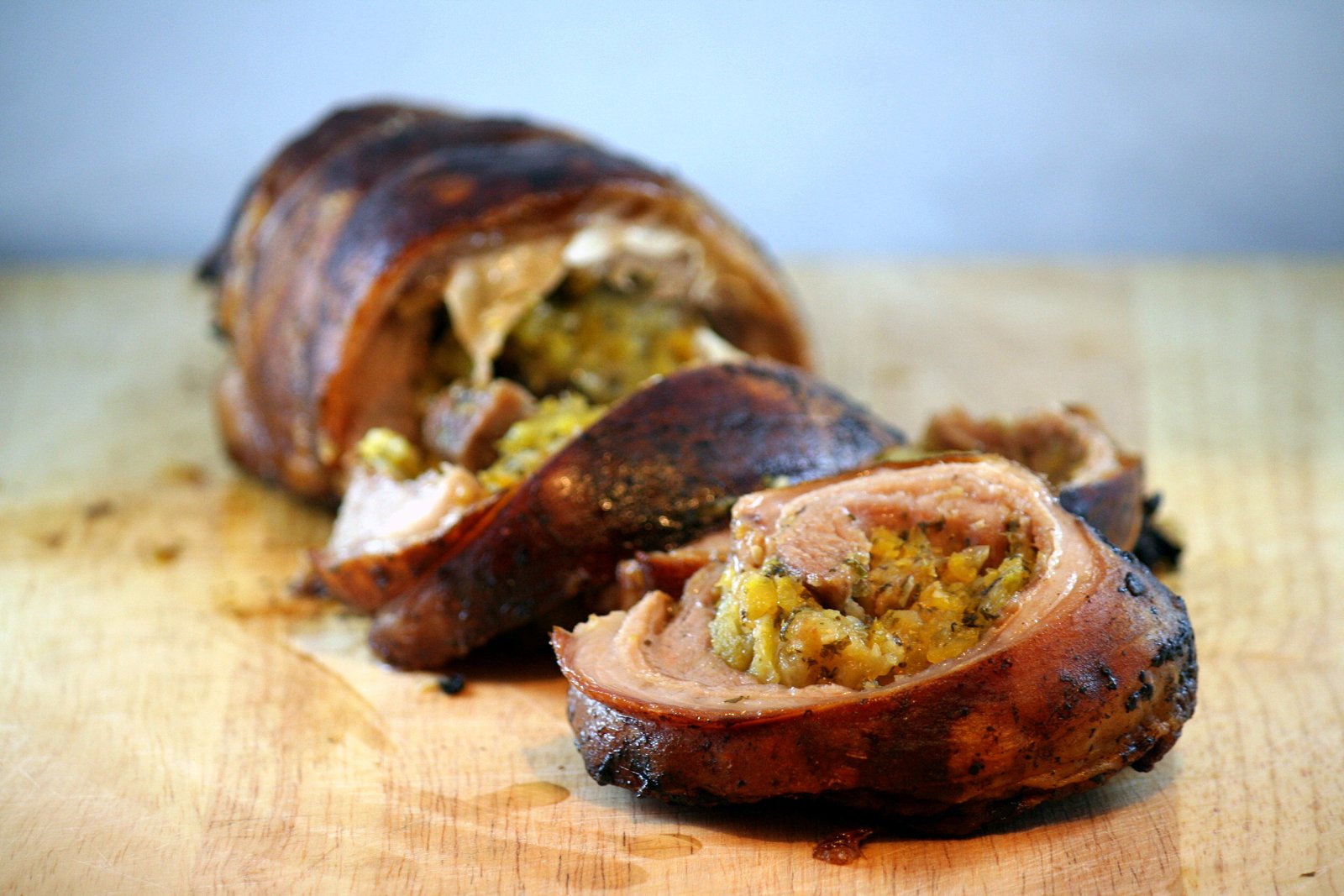
Lamb breast with apricot stuffing


Sometime ago food was not widely available and was not relatively cheap people were not wasting any bits i.e. after slaughtering a cow, only because some bits were less tasty than others or needed more effort to cook. It is not only the industrial revolution age that I am writing about when some people's only dinner were cheap eat cuts or offal; the food was rationed in Britain until mid fifties. People in age of fifty or so do not remember those days but older generation still remember times when some product were difficult to get hold of.

The food market has changed and in general the food is widely available and relatively cheep nowadays for most western societies. Some of the old times dishes are nearly forgotten now. You still can see some offal on the menu in traditional pubs or some good restaurants, but these are not very popular in many homes. It is similar with some cheap cuts such as belly pork that I showed you on this blog and lamb breast that I am showing today.

Both cuts are very cheap and I have to admit that they are not extremely meaty but fatty. However fat makes them really tasty, aromatic and meet underneath is very tender. Coked in low temperature for long time will provide lovely crispy skin and the centre that melts in your mouth. All they need is bit more time to cook and few culinary tricks.

Today the recipe for lamb breast stuffed with apricots. There are not many recipes on-line so I have asked my butcher how to cook it and I have improvised with the stuffing. The result was amazing and I going to cook this cheap, tasty, forgotten cut more often.


Serves 2


ok. 700g lamb breast
1 onion, peeled and chopped
2 garlic cloves, peeled and roughly chopped
handful of dried apricots
2 slices of stale baguette, diced
4 tbsp olive oil
small handful fresh mint
freshly ground black pepper
lemon & thyme salt (or sea salt)
cup of vegetable stock
3/4 cup of dry rd wine

Fry the onion in the 3 tbsp olive oil until soft but not browned. Add the garlic and fry for another minute or so. Remove from the heat and set aside to cool down slightly.

Place diced baguette, apricots, mint, some salt and pepper in the food processor. Add fried onions with garlic making sure you scrap as much olive oil as possible - it will help the stuffing come together. Process, but not until very smooth, but some little pieces of fruit are left.

Smear the stuffing over lamb breast, roll it and secure with a string. Heat the remaining olive oil in the pan that you have used for frying the onion and brown the meat on each side over a high heat.

Place the meat in an ovenproof dish, add wine and half of the stock, cover with piece of tin foil and place in the oven preheated to 140 C. Roast for about 3 hours, then uncover, add the remaining stock, turn the heat up to 180 C and roast for another 40 minutes (uncovered).

Remove from the oven, place on a chopping board, cover with piece of foil and leave it to rest for about 10 minutes.

Cut into slices and serve. We had it with potatoes, carrots, parsnips roasted in goose fat with garlic.